
Free calculation
Free birth chart with interpretation
See where the Sun, Moon and planets were at the moment you were born — and what that says about your character, relationships and calling.
Calculate my birth chartFree · no sign-up · under a minute
What a birth chart is
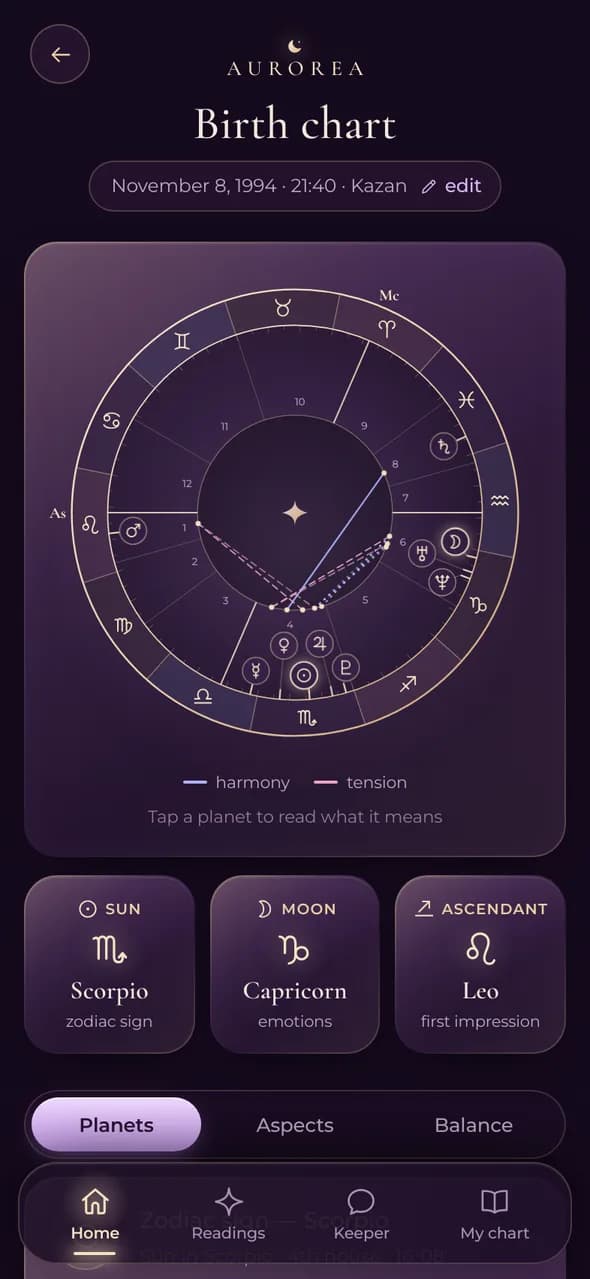
A birth chart (also called a natal chart) is a map of the sky for the exact minute and place you were born. It shows which zodiac signs the Sun, Moon and eight planets were in, which houses they fell into and what angles they formed with each other. No two charts are exactly alike: even twins can have a different Ascendant and different houses.
In astrology, the chart is read as a description of your innate tendencies: how you think, love, get angry, what you fear and what you reach for. It is not a verdict or a forecast of events, but a language that makes it easier to talk about yourself.
What a chart is made of
Planets: the “what”
Each planet governs a different side of your personality. The sign it sits in shows how that side expresses itself.
- SunCore self and energy
- MoonEmotions and needs
- MercuryThinking and speech
- VenusLove and values
- MarsAction and desire
- JupiterGrowth and luck
- SaturnStructure and maturity
- UranusFreedom and change
- NeptuneDreams and intuition
- PlutoPower and transformation
Houses: the “where”
Twelve houses divide the chart into areas of life. The house a planet falls into shows where its energy is felt most strongly. Calculating houses requires your exact time and place of birth.
- 1Self and appearance
- 2Money and values
- 3Communication and learning
- 4Home and roots
- 5Creativity and romance
- 6Work and health
- 7Partnership
- 8Intimacy and transformation
- 9Beliefs and travel
- 10Career and recognition
- 11Friends and dreams
- 12The unconscious and the hidden
Aspects: the “how”
Aspects are the angles between planets. A conjunction (0°) blends two energies into one. A trine (120°) and a sextile (60°) give natural talent. A square (90°) and an opposition (180°) create inner tension that pushes you to grow.
Sun, Moon and Ascendant: the “big three”
Every chart reading starts with these three points. Sun is the core of your personality and your source of energy: what people usually call “your sign.” Moon is your emotions and needs: what calms you and gives you a sense of safety. Ascendant (your rising sign) is the sign that was rising on the horizon at the moment of birth: the first impression you make and the way you step into something new.
How Aurorea calculates your chart
- Planet positions are computed from astronomical models, accurate to the arcminute.
- Your birth time is converted to universal time using historical time zones and daylight saving changes in your city.
- Houses use the Placidus system and the zodiac is tropical, as is standard in Western astrology.
- Aspects are found with orbs of 5° to 8°, wider for the Sun and Moon.
Once the chart is ready, you get the chart wheel, a list of planets by sign and house, an aspect table and an element balance. You can open any item and read its interpretation. And if questions remain, you can ask the Keeper, a guide who sees your whole chart.
What to explore next
A birth chart works well alongside other tools: compatibility by date of birth shows how your chart fits with the chart of someone close to you, and the Destiny Matrix describes your character and purpose through 22 energies. For a closer look at each sign, see zodiac signs.
Birth chart questions
What do I need to calculate a birth chart?
Your date, time and place of birth. The date sets the planets' positions in the signs, while the time and place determine the Ascendant and houses. The more precise the time, the more accurate the chart: the Ascendant moves about 1° every four minutes.
Can I get a chart without my birth time?
Yes. Planets in signs and the aspects between them will be calculated correctly. Without a time, the Ascendant, Midheaven and houses can't be determined, and the Moon's position will be approximate.
Which house system is used?
Placidus by default, the most widely used system in Western astrology. For places beyond the polar circle, where Placidus doesn't work, the Porphyry system is used. The zodiac is tropical.
How is a birth chart different from a sun sign horoscope?
A sun sign horoscope only considers the position of the Sun, which is the same for everyone born in the same month. A birth chart takes into account ten planets, twelve houses and the angles between them, so it is personal to you.
What are aspects?
An aspect is the angle between two planets. Harmonious aspects (trine, sextile) show what comes easily. Tense ones (square, opposition) point to inner conflicts that, with conscious work, become a strength.
Does a birth chart change over time?
No, it is a snapshot of the sky at the moment of birth. What changes are transits, the current positions of the planets relative to your chart. Astrologers use them to describe periods of life.
Build your birth chart
An exact calculation and interpretation of planets, houses and aspects — free.
Calculate my chartNo sign-up · your first 3 readings are a gift